

The original version of this reportage is in German and was published in Wochentaz
In Glückstadt, Germany, many houses look finished down to the smallest detail. In Calabria, by contrast, some façades remain unfinished. What can a house tell us about the people who live in it?
On a small table, various objects are arranged neatly and symmetrically: books, little ornaments, old cups, scissors. In Glückstadt, an elderly German woman is sitting outside her house, selling things she no longer needs.
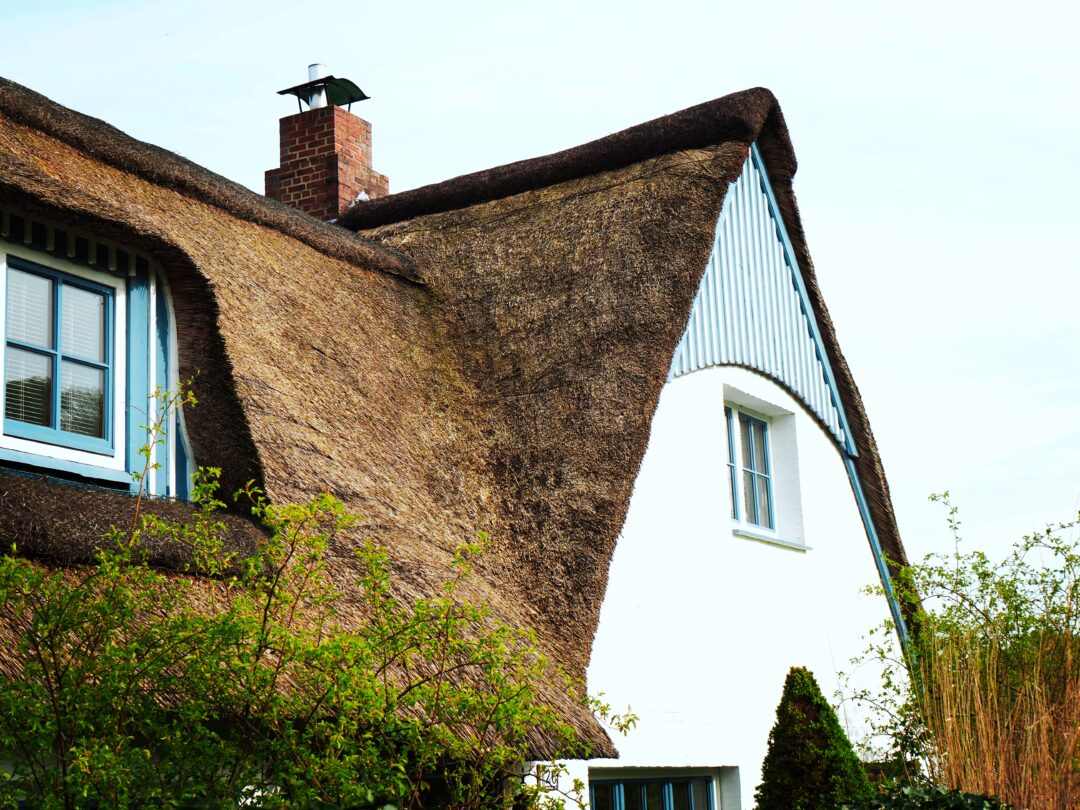
The house is immaculate. Its white walls, the dark lines of the façade and the green-painted door look almost staged. Many houses in this area look like this: hedges trimmed into straight lines, gardens laid out as if according to a plan, firewood stacked so carefully that the pieces almost look like Lego bricks.
I buy a small pair of scissors from the table, and the elderly woman seems pleased.
“Could you live in a flat that wasn’t tidy?” I ask her.
“No, absolutely not. I couldn’t,” she replies. Then she looks at her front door and adds: “Although… even here, there are still lots of things that haven’t been done. I’ve lived here for forty years. Actually, I should repaint the door.”
The scratches on the door are barely noticeable. You only see them once she points them out.
A friend standing beside her nods. “It’s simply part of feeling at home. Of course, there are Germans who want everything to look perfect. Almost obsessively, so that everything looks tidy from the outside. But I’m not like that. I take care of my flat for myself!”
Behind a glass door, shoes are lined up with almost obsessive precision, one beside the other. A small robotic lawnmower moves tirelessly and silently, circling the same patch of grass for hours.
And yet, a strange feeling comes over me. Standing in front of these houses, I feel as though I myself were an element of disorder. At the same time, I am drawn to them.
I grew up in Sardinia among unplastered façades and unfinished building sites, and I cannot help wondering: how do you make a place look so finished?
Here in Glückstadt, the boundary between what is finished and what is not seems to lie somewhere else. Even a scratched door stands out, although you only notice it when someone points it out.
Curiosity makes me search for irregularities, but for a long time I cannot find any. The little sheds used for tools or gardening are often better kept than many residential houses where I come from.
Until, eventually, I find a house that looks different: the garden is overgrown, old objects lie scattered in front of the door.
I walk closer, hoping to meet someone. But the house is empty. No one lives there.
The only house that looks unfinished is also the only one that is uninhabited.
Jasmine, an Italian woman who has lived in Germany for twenty years, runs a small restaurant in the centre of Glückstadt. Italian pop music is playing inside, and pictures of Italy hang on the walls. The restaurant feels less like a place in Italy than a vague memory of it.
Jasmine finds all this order excessive.
“For me, it’s too much,” she says. Yet as she speaks, she straightens the glasses and smooths the creases from the napkins. Her hands do not contradict her. They simply reveal that they learned this order a long time ago.
“But that’s what life is like here: work, home, work. After ten at night, there’s nothing going on anymore. I go to bed.”
Her daughter stands beside her and smiles. She has an Italian name, but she does not speak Italian.
If she could choose, Jasmine says, she would live in Naples. But by now, the life she has built is here. Her restaurant, however, is called “Casa Mia”.
Outside, Glückstadt begins again.
A few hours later, I am on the bus when the driver points irritably at the grass along the roadside.
“No one takes care of this anymore,” he grumbles. “In the Netherlands, everything would be properly looked after!”
I had not even noticed the grass.
I then travel south, to where people dear to me live, and where façades tell very different stories.
In Calabria, even the unplastered walls seem to have a sound. Through an open window comes the voice of a television turned up very loud.
Now I am standing in front of a façade that would probably attract immediate attention in Glückstadt.
“There isn’t much space here. The houses were built badly, everything was a bit unregulated,” says Mimma, a woman of around eighty who has lived on the outskirts of Reggio Calabria for decades. “Anyone who had even a small piece of land built on it. They could have built elsewhere, but there were no roads there and the municipality didn’t take care of it.”
There are well-kept plants outside the front door. But the façade has never been plastered. The scratched brown metal door looks as though it belongs to another era.
“At the time, the state offered money to make the outside of houses look nice. But because our houses weren’t entirely legal, we couldn’t do it. We built the house with our own surveyor, without the municipality. To get it regularised, you would have needed connections. Around here, really, nobody is completely in order.”
Behind the door, the concrete staircase looks like part of a building site that was never completed. Yet the worn steps and the smell in the air tell of decades of life lived here.
“Doesn’t it bother you that the house still isn’t finished on the outside?” I ask her.
She smiles. “Of course I’d like it to be finished. But if I spend the money on the outside, I can’t help my children. You either do one thing or the other.”
“If you have a lot of money, you can do everything.”
Her eyes lift towards the image of Jesus beside the door.
“It all depends on your wallet!”
“If we’d had more money, maybe we would even have built a lift.” When the conversation turns back to the appearance of the façade, she starts talking again about her son Bruno and the heavy shopping bags he has to carry upstairs.
For Mimma, a house does not seem to become finished when the last wall has been painted. It is finished when space has been made inside it for the family.
In Calabria, many houses used to be built upwards, not only because space was limited, but also so that one day a son or daughter could live there. Several generations often lived in the same house.
“Parents sacrifice themselves for their children. Maybe they give up buying a pair of shoes, they don’t go to restaurants, they give up everything just to help their children.”
Mimma spreads her arms as if to say, “What can you do?”
As she speaks, an elderly man can be heard outside, loudly swearing at the television.
Perhaps in Calabria, order is found less on the façade and more inside the home. In Glückstadt, by contrast, it begins at the very boundary between the home and the outside world.
Both are forms of order, simply facing in different directions.