


An ancient Sardinian ritual and the search for belonging in a changing world
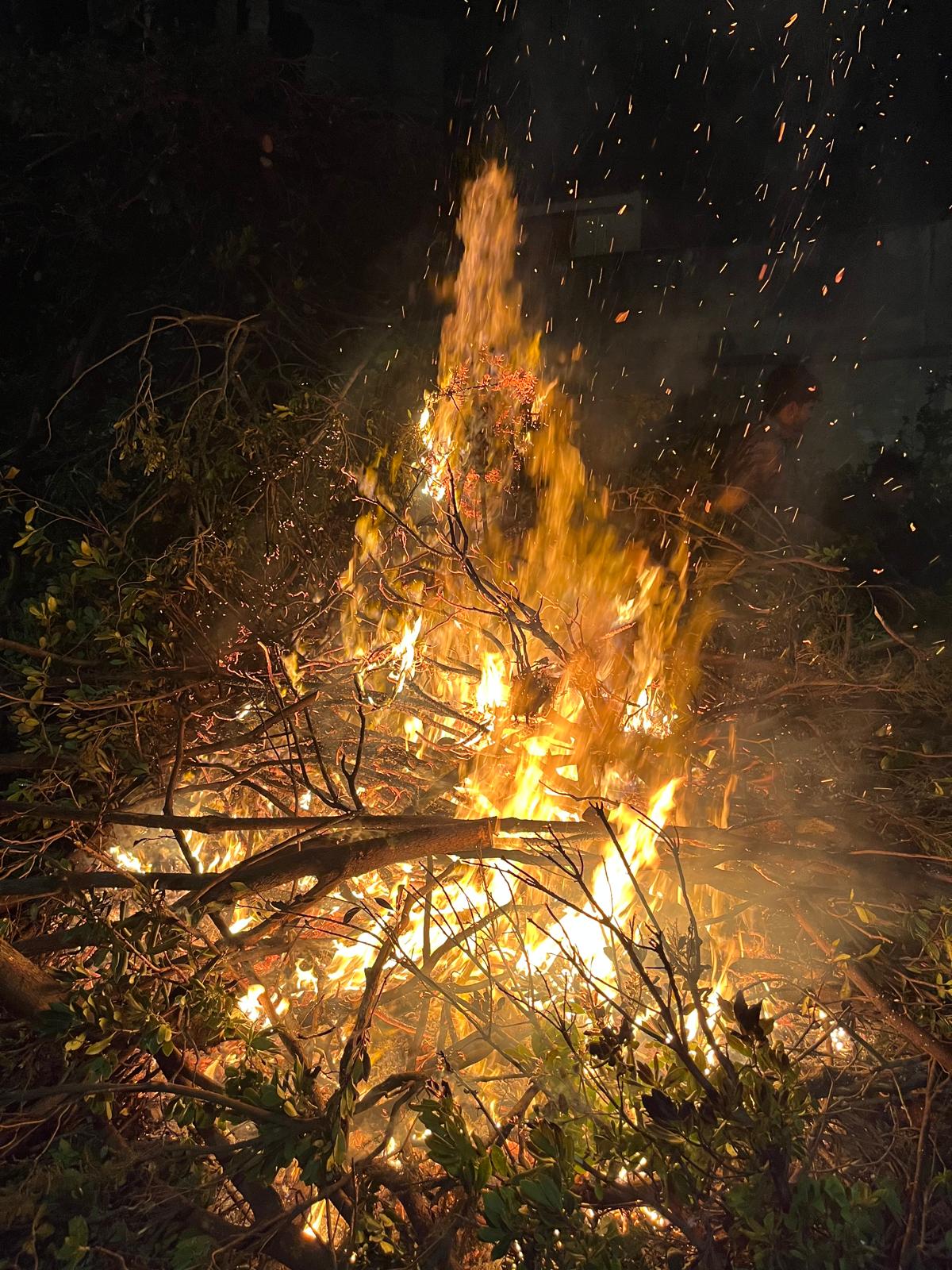
There is a smell of burning in the air, but beyond the smoke rising from the mastic branches, something else seems to be burning: the eyes of the young people gathered around the fire. They burn with something difficult to name. Perhaps excitement, perhaps restlessness, perhaps the weight of something they themselves do not fully understand.
Every January 16, in Lodè, a small village in the mountainous interior of Sardinia, people gather to celebrate Saint Anthony the Abbot. But calling it a celebration hardly captures what happens here.
In the morning, men collect branches for the bonfire, while women traditionally remain at home to welcome children who go from door to door, taking part in a custom somewhat reminiscent of trick-or-treating. By evening, the village gathers in the main square. At its centre stands an enormous eucalyptus trunk, firmly planted in the ground. Branches are set alight around it, and men compete to climb to the top.
That, at least, is what an outsider might see.
But for those of us who grew up here, January 16 is something more difficult to explain.
I was born and raised in Sardinia, but I left the island when I was nineteen. Since then, I have spent years moving between two worlds, never entirely belonging to either. And yet, whenever I return to Lodè for this celebration, I experience a feeling so intense that I struggle to put it into words.
Perhaps that is precisely what makes this tradition so fascinating: it seems to preserve something we can still feel, even when we no longer know how to explain it.
The celebration is officially dedicated to Saint Anthony the Abbot, a Christian saint associated in Sardinian folklore with the gift of fire to humanity.
According to a local legend, Saint Anthony descended into hell and managed to bring fire back to the world.
Across Sardinia, celebrations in his honour feature bonfires and local rituals. These traditions are often interpreted as preserving elements of older, pre-Christian beliefs, although their precise origins and meanings are not always easy to establish.
In Lodè, the coexistence of religious ceremony and popular tradition creates a particularly striking contrast.
Before the climbing begins, the priest circles the burning branches three times. Nearby, young men, many already affected by the wine they have been drinking, wait impatiently for the ritual to continue. The priest, the flames, the wine and the enormous tree trunk all belong to the same celebration. Yet they seem to speak different languages.
There is something almost theatrical about this encounter between religious solemnity and collective excitement.
And then there is the wine: not wine as the blood of Christ, but wine as an invitation to loosen the rules that govern everyday life. During the celebration, it seems to open a door to a freer, more unruly side of human nature.
It is tempting to think of Dionysus, the ancient Greek god associated with wine, ecstasy and the temporary dissolution of ordinary boundaries.
The comparison is not an explanation of the ritual’s origins. It is simply one way of describing the atmosphere: for a few hours, the familiar order of village life appears to loosen. Meanwhile, the fire continues to burn.
Throughout history and across cultures, fire has been associated with destruction, renewal and purification. In Lodè, these associations seem particularly evocative, even if the ritual’s historical meaning cannot be reduced to any single interpretation.
What interests me most, however, is not only what the fire may once have represented, but what it means to us today.
Sardinia is an island with a complex cultural history, distinct linguistic traditions and a strong sense of local identity.
Yet for many young Sardinians, belonging is not necessarily a simple matter: we inherit traditions, expressions, gestures and memories whose origins we often know only vaguely. We sense that they are part of us, but we may struggle to understand what they mean in the world we inhabit today.
I sometimes wonder whether this creates a particular kind of restlessness: to have a sense of where you come from, without being entirely sure who you are, can be painful.
Of course, uncertainty is part of being young. But I suspect that, in communities such as Lodè, it can also reflect a wider tension between inherited ways of life and a rapidly changing present.
The past remains powerful. Sometimes reassuringly so. Sometimes almost overwhelmingly.
There are moments when it feels as though we are holding on to old traditions not only because we value them, but because we do not know what might replace them.
And perhaps this is where the meaning of January 16 becomes more complicated.
Traditions are supposed to connect the past with the present. They survive because people continue to give them meaning.
Perhaps traditions remain alive precisely when we are willing to look at them again, to understand what they meant to those who came before us and what they might still mean to those who come after.
Every January 16, the fire returns to Lodè.
The branches burn, the priest performs the ritual, the young men gather around the enormous trunk, and the village becomes, for a few hours, the centre of its own world.