

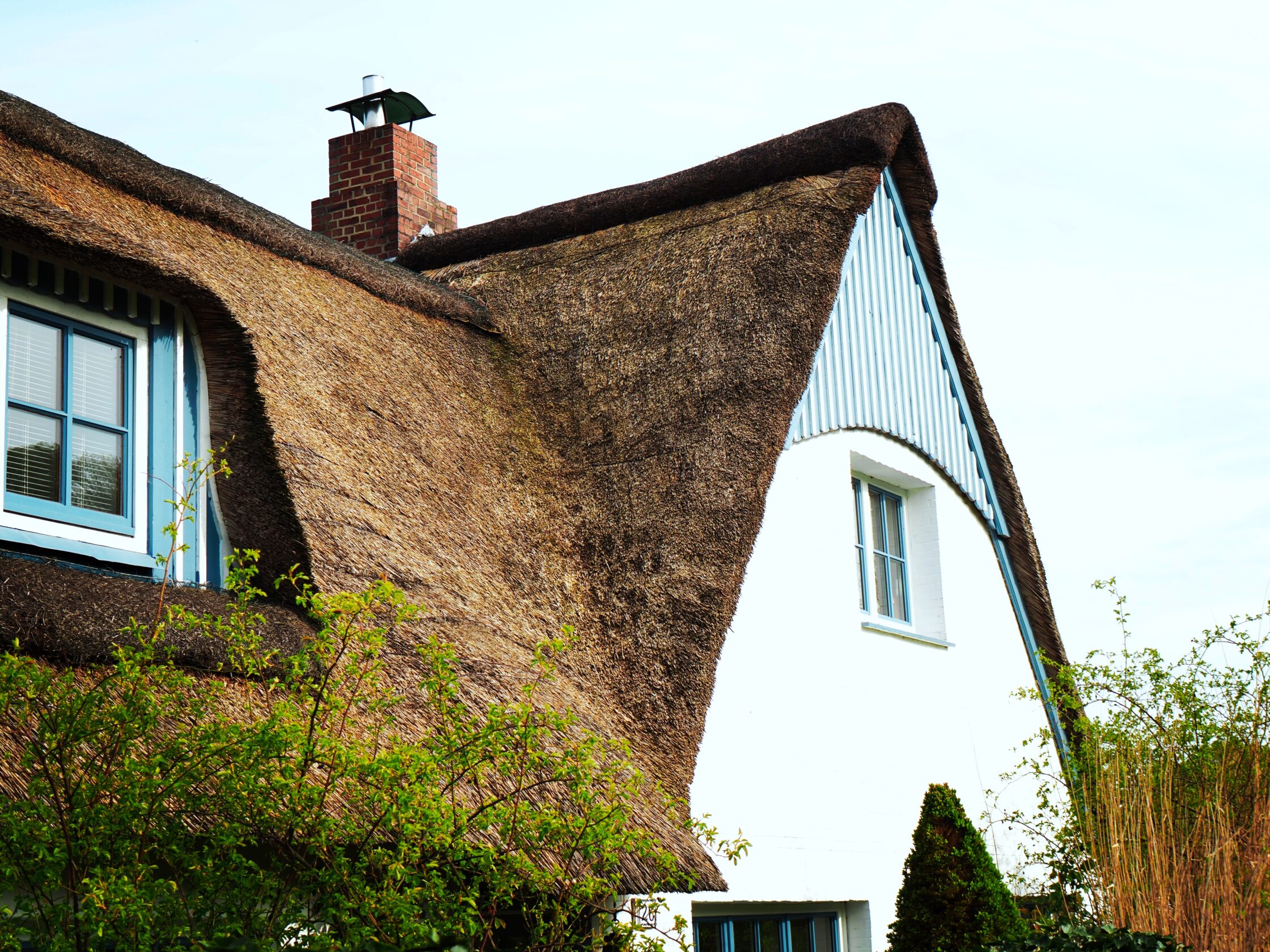
In northern Germany, there are many houses with steep roofs made entirely of reed. From a distance, the landscape looks like dark cotton sheets laid over the rooftops of houses that are already quite charming, and so perfectly ordered that simply walking past them makes one feel like an element of disorder.
“That kind of roof costs a lot of money,” the bus driver tells me as we chat about various things. “And it’s not just the installation, it’s also the maintenance and the insurance you have to take out.”
In fact, installing this type of roof, known in German as Reetdach, costs about three times as much as a standard roof. Then there’s the maintenance and the insurance, which, due to the high risk of fire, is very expensive.
And yet these roofs are of very ancient origin, and of course, in the past there was no money and no insurance: the only goal people had was to survive.
Reeds were abundant here near the Elbe, and they were perfect for insulating against both heat and cold.
So how did we move from “I use reeds because they are there” to “I choose reeds because I can afford them”?
First of all, while reed roofs were once widespread because people had no alternative, with modernity they have become increasingly rare. And, as basic economics teaches us, what becomes rare acquires value.
Then there is our constant tendency to romanticize what once was and is no longer. The nostalgic idea of an “authentic” past is a recurring human weakness, which leads us to aestheticize even what originally had little to do with beauty, since it was simply the result of hard labor and the struggle for survival.
And this is where the most interesting anthropological aspect of this story lies: modernity transforms necessity into privilege. It turns it into a choice. And since the ability to spend a lot of money on something that is no longer necessary is relatively rare, it becomes a sign of prestige.
Today, only a few professionals in Germany still know how to build reed roofs, so having one has become a real status symbol of economic well-being.
In essence, to connect this to the theories of Lévi-Strauss, a significant shift has taken place: from focusing on the material itself (the reeds) to focusing on its symbolic meaning (prestige).
A similar example can be found in Sardinia. In my hometown, Lodè, wine used to be by far the most widespread drink (apart from water, of course). Many people had their own vineyards and therefore their own wine. To let others know that the new wine was ready, and that it was time to taste it, and possibly buy it, people would place a branch or a broom outside their door.
A simple, almost primitive signal, from which the Sardinian term s’iscopile developed (derived from the word iscopa – broom), the precursor of today’s bar, where even beer did not yet exist. It was a spontaneous form of social life, with very little staging.
Today, that same wine has become almost an aesthetic ritual: served in crystal glasses, described in the technical language of sommeliers, it can cost as much as a kidney, and is probably less “valuable” than the wine once offered in s’iscopile.
Thus, what was once a sign of lack has become a sign of distinction.
Perhaps it’s worth paying attention to when we stop consuming things themselves and start consuming their meaning.