


Today I want to tell you a different story. A story that has been widely discussed in Germany, but barely mentioned in Italy.
We are in Berlin. Hüseyin Doğru, a journalist of Turkish origin with both Turkish and German citizenship, simply wants to go grocery shopping. But all his bank accounts have been frozen, and when he reaches the checkout, he cannot pay.
On X, Hüseyin says he can no longer provide food for his family, including two newborns, because of the sanctions imposed on him by the European Union in May 2025.
“The EU has, in effect, sanctioned my children as well,” he writes.
The question is obvious: what could he have done that was so serious?
Doğru is the founder of an online platform called RED.
According to the European Union, RED is not an independent media outlet.
It is said to have links to Russian state propaganda, to have spread content that fuels division in Germany, and to have amplified narratives associated with radical Islamist groups such as Hamas.
It is also accused of playing a role in the protests at the Free University of Berlin.
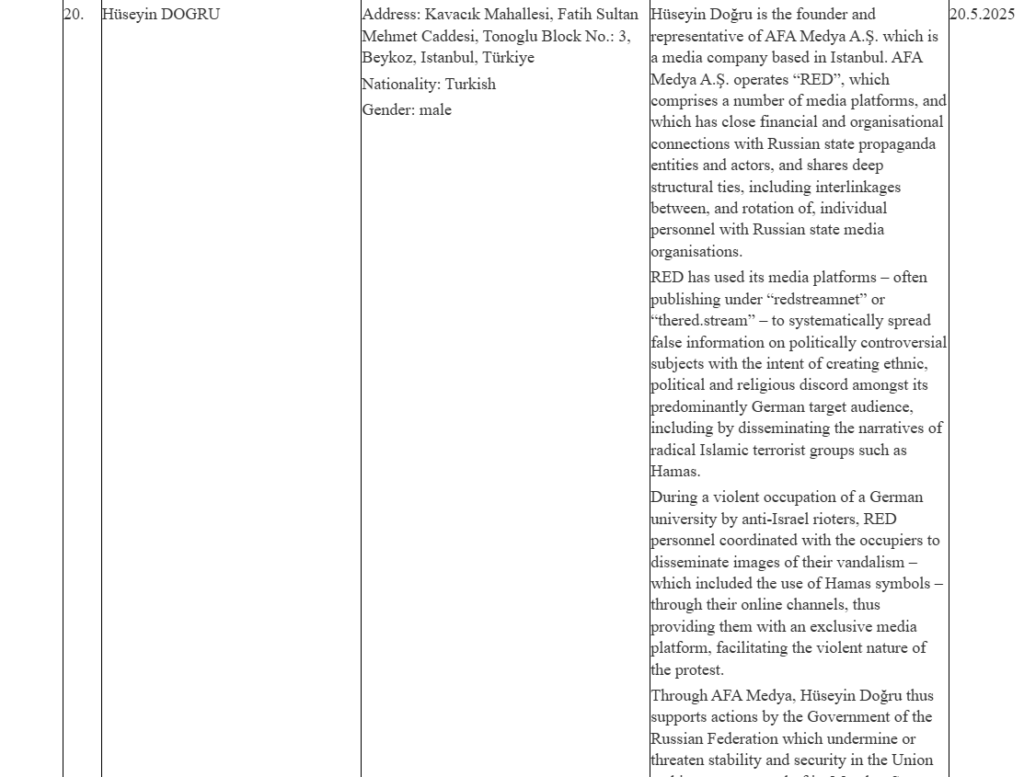
These sanctions are part of the EU’s response to so-called “hybrid threats”:
a type of attack that does not rely on weapons, but on information.
The idea is that a state can weaken another not only through military means, but by influencing public opinion, creating tension, and fostering distrust.
But there is a problem.
No publicly available contracts, financial records, or staff lists demonstrate direct links to Russia.
The EU documents do not provide specific examples, links, or content that would allow the alleged disinformation to be verified.
Even regarding the protests at the Free University, it is possible to see what circulated, but not to verify the extent of RED’s alleged coordinating role.
The German government states that RED was deliberately used by Russia to manipulate information, based on a national attribution procedure.
However, when the journalist asked for concrete evidence, the Foreign Office stated that it could not go into the details.
In other words: there is an official decision, but the evidence behind it is not publicly accessible.
This raises a deeper question: How far can measures go in the name of security without making the reasons behind them transparent?
The European Union often criticizes other countries for restricting press freedom, referring to them as “authoritarian regimes.”
But when similar measures are taken within its own borders, a simple question arises:
is this really protection or also a form of control?
https://www.auswaertiges-amt.de/de/newsroom/regierungspressekonferenz-2725706
https://eur-lex.europa.eu/legal-content/EN/TXT/?uri=OJ:L_202500965