

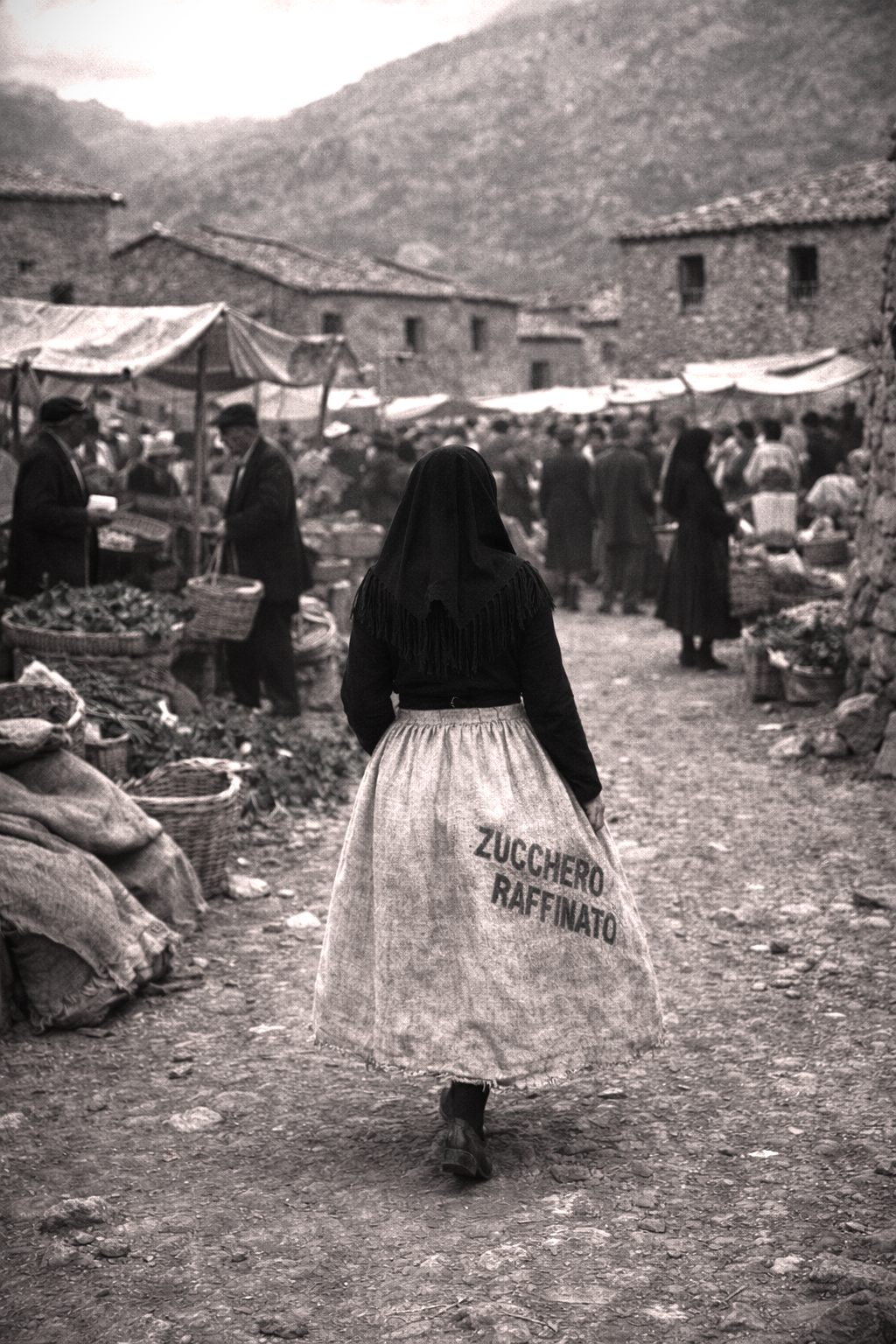
In my village, there was a woman who used to walk around wearing a jute skirt with the words “Refined Sugar” printed on it.
Today we would think she was crazy, but in the 1950s, in Lodè, it really happened, and my grandfather remembers it well. He never thought she was crazy.
There may have been a few ironic comments, but the reason was no mystery. In the village, everyone knew: clothes were made from whatever was available. That woman only had an empty sugar sack at home, and she turned it into a skirt.
People did this all the time. For example, they made wooden clogs out of pieces of wood, even if they hurt their feet, because it was still better than walking barefoot. And at home, clothes were passed down from one child to another. Sleeves were shortened, then lengthened again, then shortened once more.
Every now and then, a man would arrive in the square with sacks of old rags, and people would rush to gather as much as they could in order to make clothes.
This is how Tzia Adelina, a ninety-year-old seamstress from Lodè, learned to sew. She would go there when the rags arrived, and already at that point the creative process would begin: what could come out of this old piece of fabric? A shirt, a pair of underwear, some socks?, she would wonder.
A sack could become a skirt, a piece of wood a pair of clogs: looking at a piece of wood and seeing a table, looking at stale, hardened bread and, instead of throwing it away, turning it into a soup. Like zuppa gallurese, once made from leftover bread, now found on gourmet menus.
Today, a bag that imitates a garbage sack can cost nearly 1800 dollars, as in the case of the “trash bag” launched by Balenciaga in 2022.