

How did we go from blood hidden beneath a petticoat to publicly funded menstrual products?
“Cussa pesta m’est ènnita”, that plague has come upon me. That is what women used to say when they got their period.
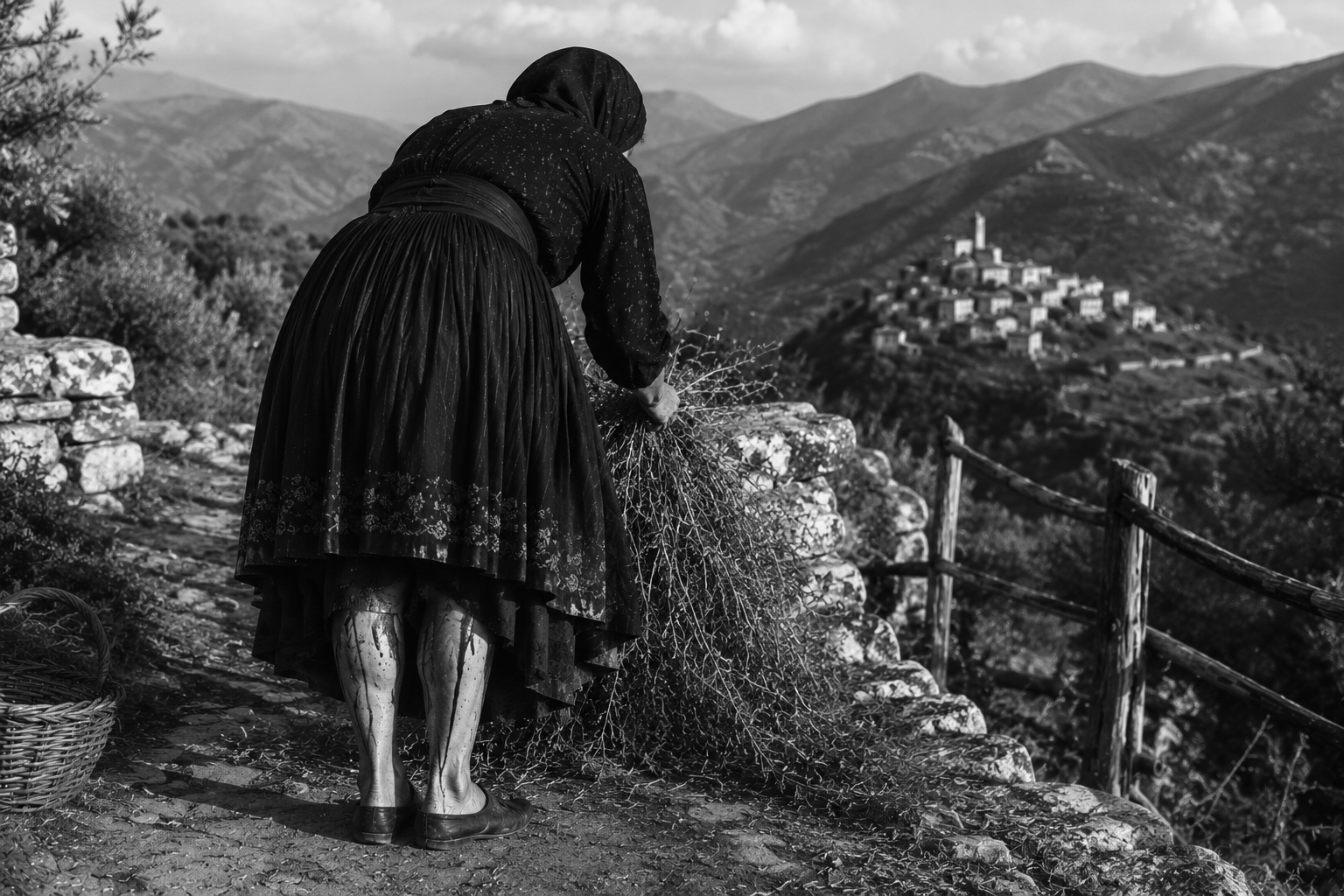
“Mancu mudandàs teniamos!”, we did not even have underwear, Tzia Pretonillia, my 92-year-old neighbour, tells me. “We wore nothing but a skirt and a petticoat. And we went barefoot.”
So the obvious question comes to mind: “What did you do when you had your period?”
“E coente achìamos?”, what were we supposed to do? “We pinned the two ends of the petticoat together with a safety pin. The fabric absorbed what it could, which was very little. The blood ran down to our calves and feet, and we simply carried on working.”
A few hours later, I read a headline in the journal: “Free sanitary pads for under-18s: Sardinia allocates €14.7 million.”
The distance between these two images is enormous.
What stands out most in Tzia Pretonillia’s story is that discomfort did not bring the day to a halt. Not because it was any less humiliating, but because there simply was no alternative. You carried on.
“S’ordinaria”, “su mese”, “su marchese”, “sa règula”: menstruation had many names. But in rural life, periods and, more broadly, the needs of the body were given very little space. Work came first. The need to keep going came first.
Today, thankfully, it is unthinkable to us that a girl should have to carry on working while blood runs down her legs.
And yet only a few generations separate a condition that now seems extreme to us from a regional government deciding to devote public money to menstrual products.
There is little point in claiming that women back then were better than women today. But it is worth recognising that they lived under conditions that constantly trained them to endure frustration, physical strain and adaptation. To stay silent in the face of pain.
Stories told by older people help us understand precisely this: a world we never experienced ourselves. A world in which character was shaped by a daily life that was harder, slower and far less protected.
If you pay close attention, you can still see a different relationship with things in many people from that generation: things are kept, repaired, reused; something is made out of very little. Not because they were inherently better people, but because life had taught them not to take anything for granted.
Today we enjoy enormous privileges. We are no longer forced to regard every form of suffering as inevitable. We can recognise a need and try to address it, even through public policy.
The question is whether, along with unnecessary suffering, we have also removed every form of friction from our lives.
A life in which everything is expected to be fast, available and accessible risks creating the illusion that every obstacle is somehow abnormal.
We do not have to choose between the world of yesterday and the world of today. But if we really want to learn from history, perhaps we should use it as a mirror: to preserve our ability to endure difficulty without having to return to unnecessary suffering.