


It was 1959 when a seven-year-old girl was given an important task: after several attempts, the family had finally welcomed its first boy, following three daughters.
She ran to the house of a family friend. Breathless, she could hardly wait to deliver the long-awaited news: “Est mascriteddu” – “It’s a baby boy.”
The woman looked at her and replied with relief: “E tando custe a dottoreddu” – “Then he’ll become a doctor.”
That little girl was my father’s sister.
Nearly seventy years have passed. Today, no one would openly say, “Congratulations on having a son.” Or at least, very rarely.
And yet I wonder whether that way of looking at children has really disappeared, or whether it has simply changed its clothes.
After a lively discussion with friends about having children, I found myself asking a question: our desires seem like the most personal thing we have, but perhaps they are also the most social.
We’re all in our early thirties.
“The first one has to be a boy,” one of them said.
“Yes, because I wouldn’t be able to do the same things with a girl,” another replied.
Why do these sentences still sound so natural? And are we really sure that this desire belongs entirely to us?
I can’t remember hearing many people say, “I hope the first one is a girl.”
If our preferences were purely individual, we would expect them to be more or less randomly distributed. Some people would prefer a son, others a daughter, with no clear pattern. Yet in many families and conversations the same preference keeps resurfacing with surprising regularity: if it’s the first child, better if it’s a boy.
At first I thought it was simply a feeling born out of one dinner conversation. Then I started reading the research. It turns out that preferences for the sex of a child vary from one country to another, and Italy still stands out as one of the European countries where a preference for sons remains more common.
Historically, this preference had its own logic: carrying on the family name, inheritance, labour, the father-son relationship, and the fear that a daughter might become pregnant before marriage.
Today, however, surnames can be chosen, daughters inherit just like sons, women work, run companies, support families, and contraception exists. Yet something seems to endure. Not in the law, but in our collective imagination.
In theory, a girl could do everything a boy does with his father. She could. And many do.
Yet we still find it much easier to picture a father with his son than with his daughter.
This is where I find myself thinking of Simone de Beauvoir. When she wrote that “One is not born, but rather becomes, a woman,” she did not mean that biology is irrelevant. She meant that a large part of what we call “femininity” is shaped by the way society looks at and treats a little girl from her earliest years.
When we give a boy a football, a toy rifle or a fishing rod, while giving a girl a doll or a toy kitchen, we are not simply giving them toys. We are also giving them possibilities.
Through those gifts, children learn who they are expected to become, and what they are expected to do or not do.
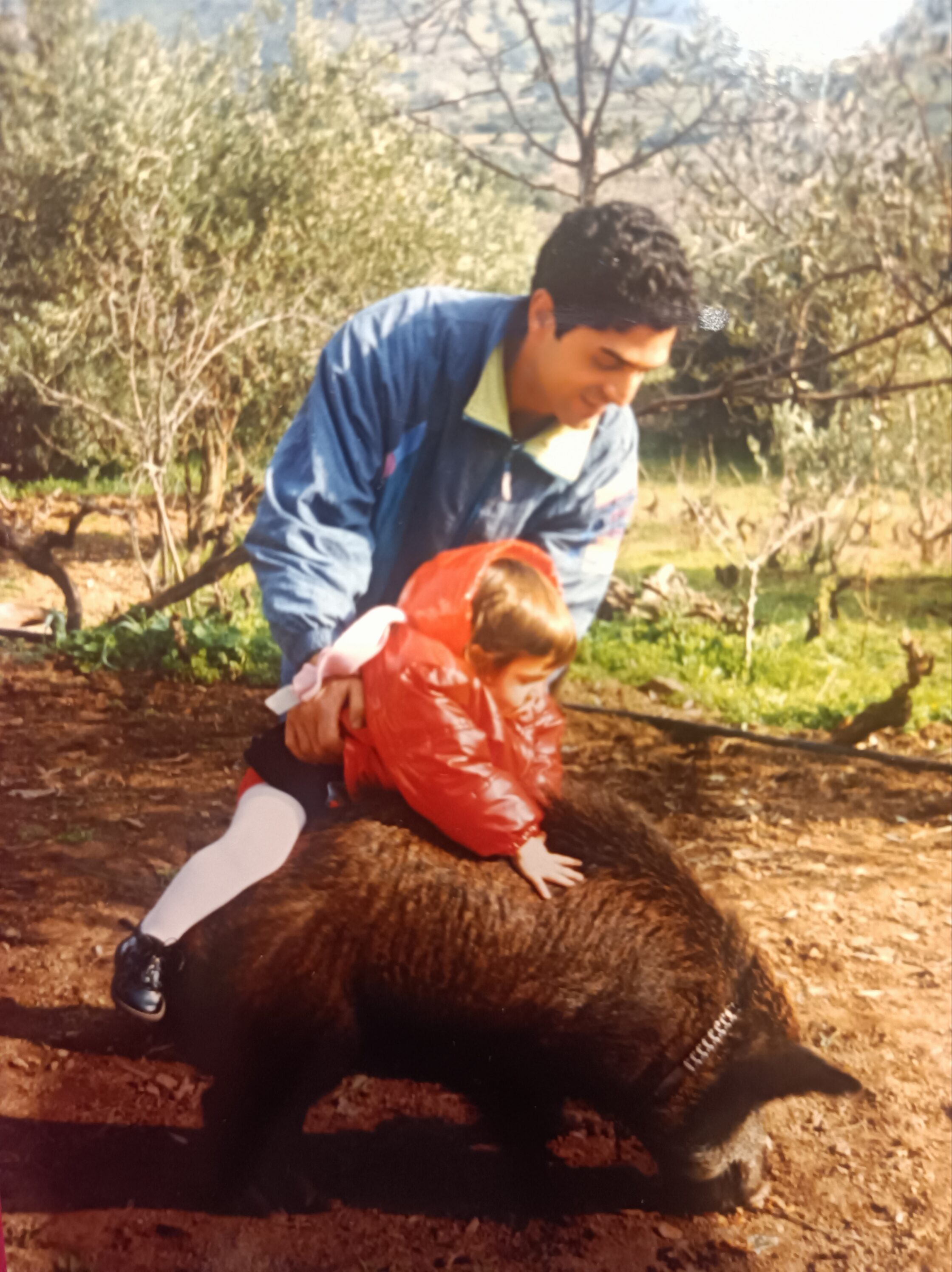
I am the daughter of a man who knows how to do countless things. He is a baker, he has a vineyard, and he knows how to grow vegetables. These are skills I consider incredibly valuable.
Yet when I left home at nineteen, I didn’t know how to bake bread, care for a vineyard, or even plant a potato. No one had ever taught me.
As an adult, I had to learn all those things from scratch, as though I were reclaiming a part of the world I had been taught to remain outside of.
If, for years, a father takes his son hunting, fishing, to the workshop or into the fields, while his daughter is gently steered towards different activities, it is hardly surprising that, as an adult, he feels he has more in common with a son than with a daughter.
Perhaps, then, we should turn the argument upside down.
Instead of saying,
“I would rather have a son because I can do more things with him,”
perhaps we should say,
“I can do more things with him because, over the years, I have built a different kind of relationship.”
The issue is not the desire to have a son.
The issue is treating that desire as something natural, without ever asking where it comes from.
Our desires are not born in a vacuum. They grow within a culture, within habits, within everyday gestures.
Perhaps before asking ourselves what we desire, we should ask who, how, when, and why taught us to desire it.
Today, no little girl would run through the village shouting, “Est mascriteddu!” And yet, without even realising it, we may still be announcing that very same news in countless other ways.