

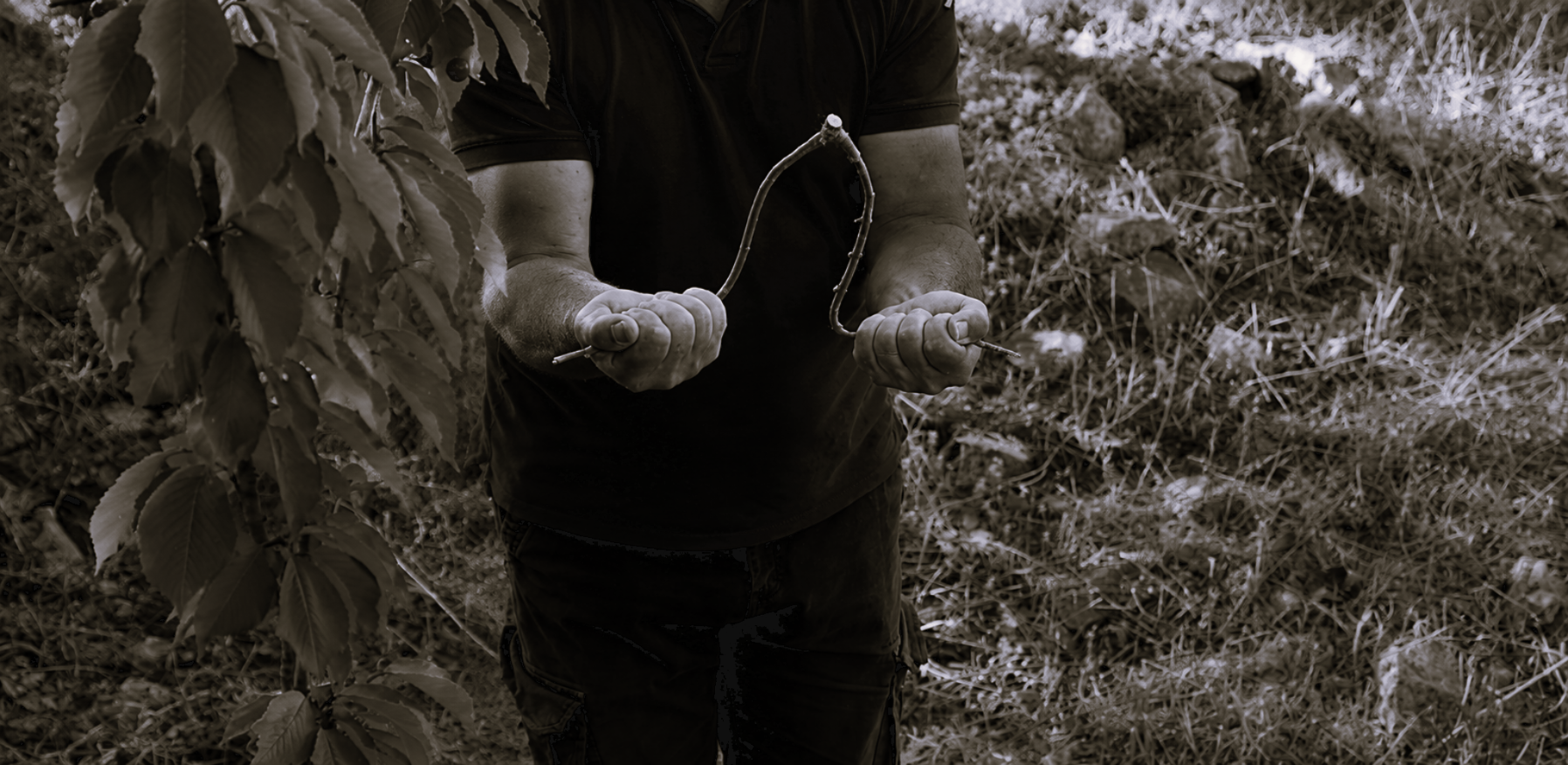
“Est’a sambenese – It’s in the blood,” says the dowser. Holding a Y-shaped branch in his hands, he moves slowly across the ground. To the right. To the left. Then he stops.
“Mi… inoca b’hat una ena – There’s a water vein here,” he says. With an open hand, he traces an imaginary line across the ground. Then he takes hold of the branch again, palms facing upward. The branch begins to move, turning downward. At one point it seems almost possessed, twisting in different directions as if it no longer knows where to point. “Cust’est una falda – There’s definitely an aquifer here.”
The man is searching for water. He is a dowser, someone who, according to many people, is able to detect underground water veins and aquifers using nothing more than a branch or a pendulum.
In Sardinia, and elsewhere, this ancient practice continues to coexist with drilling rigs and far more modern technologies.
The word rabdomancy comes from Ancient Greek and literally means “divination by means of a rod” (rhabdos meaning rod or staff, and manteia meaning divination or prophecy).
It is the belief that certain people possess a gift that allows them to sense the presence of water, or minerals, beneath the ground.
Completely confident in his judgment, the dowser has a stake placed at that exact spot and advises the landowner to drill there. Just a few metres away, he says, nothing would be found because “S’abba colata inoche – The water runs exactly here.”
None of the people present seem to doubt what he says.
When I ask how he discovered that he had this gift, he replies: “Appo provatu e minde so abbizzatu, chi lu iuco in su sambene – I tried it and realised that I have it in my blood.”
The branch, he explains, must be made from olive wood or lentisk. Otherwise it will not work.
Back at home, fascinated by this mysterious practice, I do the most modern thing possible: I start searching online.
I discover that the scientific community considers rabdomancy a pseudoscience. There are no experiments proving that it works, and there is no solid scientific evidence supporting it.
And yet, in Lodè, I meet almost no one willing to dismiss rabdomancy as nonsense.
Here, hardly anyone is surprised when a dowser arrives before the drilling rig. People believe in it so strongly that they rarely question the idea that some individuals may carry this gift in their blood. Following the advice of dowsers, considerable sums of money are spent drilling exactly where they indicate. Sometimes the owners of the drilling rigs are themselves dowsers and decide where the drilling should take place.
Drilling a well can easily cost several thousand euros. And yet, before the machinery arrives, there is often still a man standing there with a branch in his hands.
In places like Sardinia, water has always meant survival. Its absence, especially in the past, could be a real tragedy. Here, water is almost sacred. For that reason, the land is viewed not only through a geological lens, but also through imagination and the fear of risk.
For centuries, those searching for water could rely only on experience, stories, and knowledge passed down from one generation to the next. In a landscape where water cannot be seen, the dowser claims he can feel it, that he can “read” the earth. Many people continue to trust him completely.
Perhaps the point is not whether the branch truly moves on its own.
Perhaps the point is that water is not the only thing we search for beneath the ground. We continue to search for the possibility that there is something beyond what we can see.