

Among the many stories told in my village, one recurring protagonist is something we really all use every single day: salt.
Salt has always been considered sacred and divine, especially in Mediterranean cultures. Plato described it as dear to the gods, and the priestesses of ancient Rome prepared the salted mixture for sacrifices to the divinities: meat offered in sacrifice was valid only if salted. In Judaism, the idea of a “covenant of salt” even emerged: an eternal, incorruptible alliance, because salt “never spoils”. Sharing salt during a meal meant sealing loyalty.1
Since these practices came from an ancient communal world and from folklore, the Church took a long time to decide whether it was convenient or not to incorporate salt into its rites: it tolerated it, absorbed it, and condemned it at different times.
In Sardinia, it was said that spilling salt on the table brought bad luck, but throwing it behind your shoulder brought good fortune. Scattering it in the house was believed to drive away evil spirits.
Being “sàviu”, salted, means being intelligent, while being “bambù”, tasteless, without salt, means the opposite.
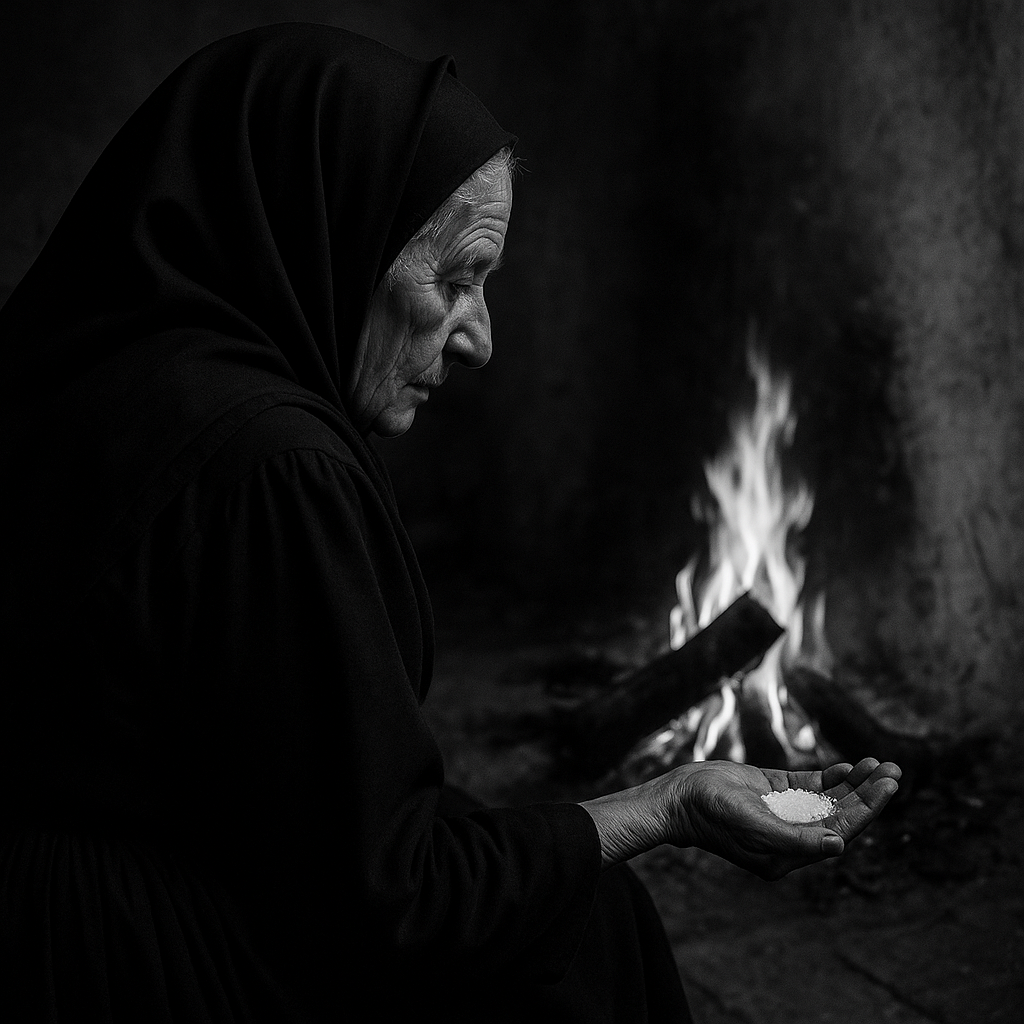
My grandmother, for example, would put salt inside a piece of cloth and sew it shut. My grandfather carried this cloth with him as an amulet, as a form of protection. Whether it worked or not, we don’t know. But since he was a shepherd and spent long periods away from the village, taking a little piece of home with him surely brought him some comfort.
There is another interesting story my grandfather tells: when he was very young, about seven or eight years old, he had warts on his hands. After many attempts, his mother went to an elderly woman in the village for advice. The woman told her to go to the village fountain, the fountain of “sa coiedda”, and throw salt “a palas issecusu”, that is, with her back turned to the fountain. She did it, and the warts truly disappeared, he says.
This woman, one of the many healers in these villages, part herbalist, part psychologist and part priestess, gave my great-grandmother a very clear gesture: to throw the harm behind her, not to look at it anymore, to leave it in the water that flows. Turning your back means “not giving it power”.
The water from the fountain would do the rest, because water erases, carries away and dissolves.
Looking at these rituals through modern eyes and assuming that our ancestors were naive makes no sense: the point is that, for people, this was a way to face the darkness, to give shape to the unknown. And the body often responds to the security of a symbolic gesture, to the emotional release it creates.
These were rituals meant to give shape to fear, to turn it into a gesture, into something the hand could do. With simple things like a cloth, salt and water, families tried to face the uncontrollable nature of life.
It was a way of being in the world.