

I remember when, at school, during Holocaust Remembrance Day, they showed us Schindler’s List, the famous black-and-white film about the Nazi period.
It was an extremely moving film, yet to us teenagers it still felt like something terribly distant. We unconsciously thought something like: “thank God it happened such a long time ago and that today we live in better times.” Almost as if we wanted to mentally protect ourselves from that horror.
I was a teenager back then, and today, a little more than fifteen years later, I can say with certainty that this mental protection increasingly feels like an illusion.
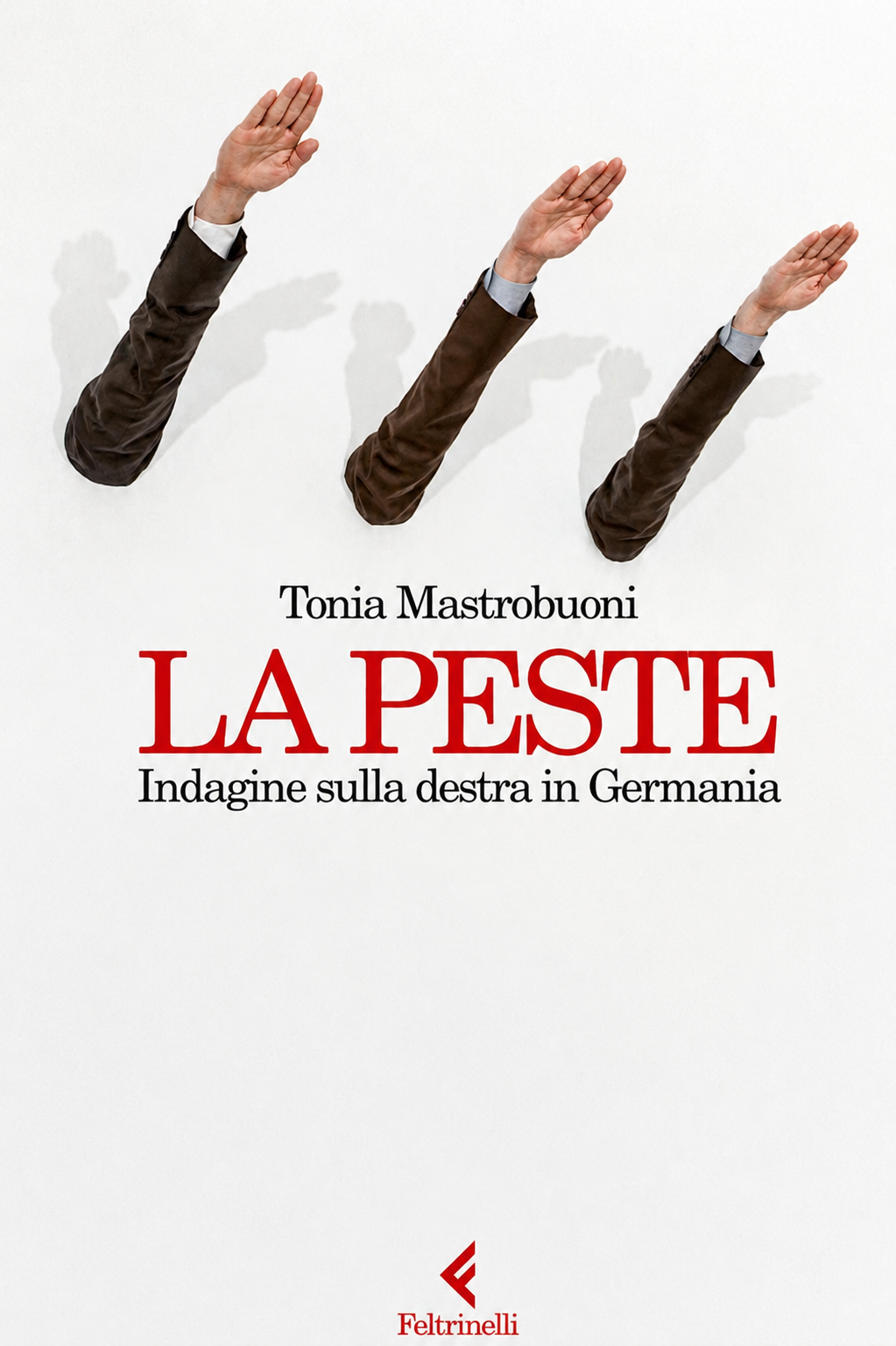
We should all read “La Peste” (The Plague) by journalist Tonia Mastrobuoni, because it tells the story of something many people stubbornly continue to consider impossible: the return of languages, ideas and mental structures that we believed belonged definitively to the past.
No, Mastrobuoni’s The Plague is not the metaphorical plague described by Albert Camus, although the parallels are inevitable. It is an investigation that digs into the most invisible corners of Germany and forces the reader to confront an issue that Hannah Arendt had already sensed after the war: at the time, the Nazis were put on trial, but not Nazism itself.
Yes, because naively we have always imagined the German far right as something marginal: nostalgic admirers of Nazism, Holocaust deniers and folkloristic figures. A bit like in Italy, where the ignorant little fascist on duty repeats phrases he has heard a thousand times, such as “when Mussolini was around, the trains ran on time,” without having the slightest idea of what fascism really was.
But part of the German far right knows perfectly well what National Socialism was. So much so that Björn Höcke, the AfD leader in Thuringia, is a former history teacher. Yet he tells history the way he wants to: some of his former students say that during his lessons he tended to skip precisely the part concerning National Socialism.
Mastrobuoni also recounts that, during an interview, one of Höcke’s statements particularly shocked her. In response to a question, he said:
“It is not my fault if my heart burns.”
It was precisely the Nazis who indulged in expressions and rhetoric like this. After the Second World War, German politics had developed an almost instinctive rejection of statements overloaded with national pathos, political romanticism and identity-driven emotion. That type of communication had become a sort of unspoken taboo.
Höcke, however, and not only him, revives exactly that emotional and symbolic language. He not only described Berlin’s Holocaust memorial as a “monument of shame” in the middle of the German capital, but in one of his books he also describes multicultural schools as a “symptom of decay.”
As do many AfD representatives who, with extreme nonchalance, constantly speak about “remigration” and use terms that only a few years ago would have been unthinkable to pronounce publicly in Germany.
But if this is the most visible façade, then behind the mask something even more deeply rooted emerges. Something dark.
The book also describes the so-called “völkisch” movements, found especially in the most forgotten rural areas of Germany. Communities that at first glance appear harmless: large families living close to nature. Discipline, organization, children raised to be impeccable.
And yet behind that normality lies an ethnic vision of society: the idea of a “pure” Germany, to be preserved by eliminating everything perceived as foreign or impure, especially foreigners, Jews and disabled people. The idea of preparing the ground for the day Germany might once again become a “Reich,” a fourth one.
Perhaps the most disturbing aspect is that these environments do not think only in terms of the present, but in generations: they prepare their children to become part of a future project. They study intensely, organize themselves and slowly establish roots in the territory without attracting too much attention.
This is where the book strikes hardest: these groups do not move through chaos or improvisation, but through method and discipline. And it is impossible not to think of a characteristic deeply rooted in German culture: the ability to organize in an extremely precise and efficient way. A quality that throughout German history has produced extraordinary achievements, but which becomes disturbing when placed at the service of ideologies like these.
And perhaps this is exactly what makes The Plague so disturbing: the fact that certain ideas do not survive only on the margins, in disorder or folkloristic nostalgia, but are capable of adapting and blending in.
The most unsettling thing is that they are in no hurry: they know perfectly well how to wait, for as long as necessary, before slowly reclaiming space in public language and in society.