

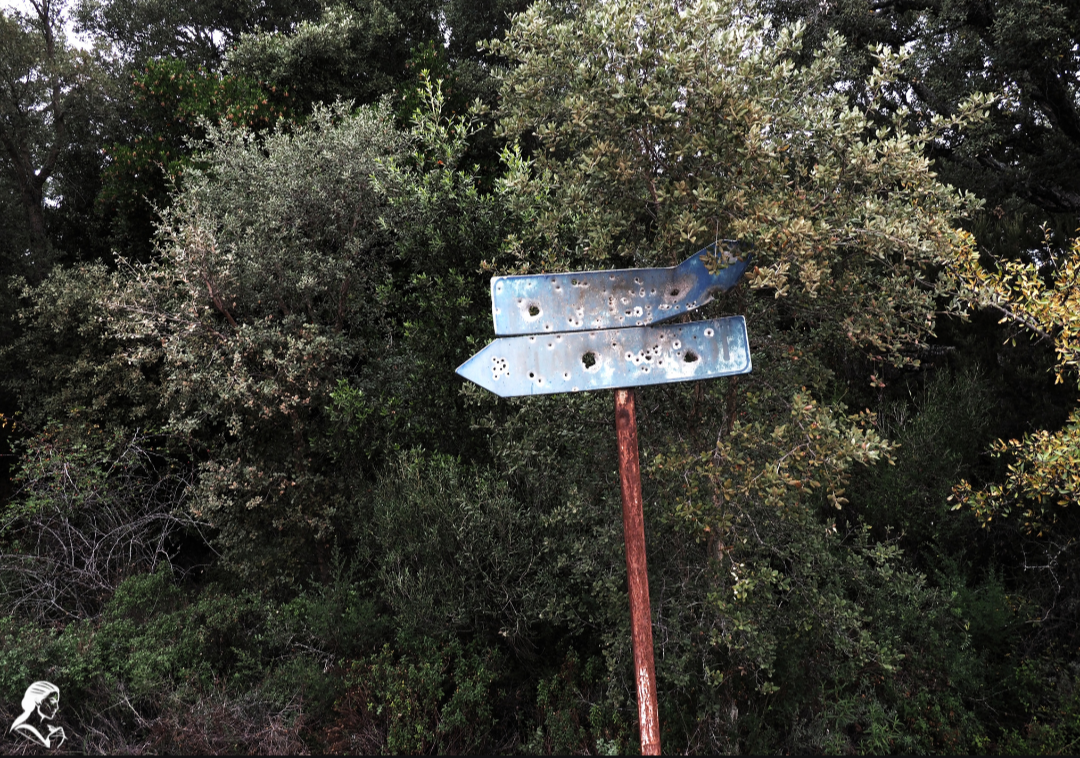
When I was little and we’d set off for some medical appointment, I never really noticed the road signs riddled with bullet holes.
But after living away from the island for many years, the last time I came across one, I instinctively took a picture.
For someone born in Sardinia, it’s completely normal. But if you stop and think about it, it’s actually kind of strange: imagine someone holding a rifle and shooting at a sign that simply points you in a direction.
Yes, that’s what objectively happens and to an outsider, it can look pretty absurd.
But to me, there’s a very clear, anthropological message hidden in that gesture.
The road sign is something placed there by “the outside”, an outside world with rules that naturally clash with the culture of local communities.
That sign, installed by the state, is a symbol. It comes from elsewhere, and brings rules that often don’t fit the local ones. Shooting at it is a raw but clear way of saying: you-don’t-run-things-here.

Anyone who knows the Sardinian inland knows this: there are unwritten laws, local codes. (I wrote about it in this article: The Remnants of the Barbaricino Code, today.)
This tension between outside and inside rules is part of a long and tangled history—too long to fully unpack here. But here’s the short version: a deep mistrust of central authority leads to gestures that symbolically reject it.
One root of that rejection lies in a history of geographic isolation and political neglect, in a people that developed its own sense of justice and order.
Add to that a bit of nostalgia and a romantic idea of the past, and you get the perfect recipe for forging a new kind of balente: proud people, armed with symbols, suspended between past and future, drawing on myth to make sense of the present.
Something similar happens in Corsica and it might help us understand this gesture better. There, people don’t shoot at signs, they erase them. They cover the French names and rewrite them in Corsican, by hand, as if to say: this is our home, and we’ll call it by its real name.
The logic isn’t far from the Sardinian one: today, in many towns, signs are bilingual. Italian and Sardinian, side by side.
And maybe that’s why, in places where the name of the town is also written in the local language, the signs stay intact just a little longer.
Because shooting at a name that feels like your own? That’s less satisfying.