

From the window of the nursing home, you can see the bright green of the Tuscan cypresses, but she, even with her eyes open, doesn’t see it.
Her eyes touch everything, but they hold onto nothing: neither us, nor her own reflection. They would still see well, if her brain allowed it. But for some time now, she has begun to withdraw into herself, slowly shriveling, and in her furrows a growing emptiness has formed, in which darkness is far too frightening: it’s like little streets of a deserted city, where only a few lights remain on.
My aunt has had Alzheimer’s for over ten years, and the progression of this disease is so cruel that it seems to exist just to remind humans of how infinitely powerless they are: there’s nothing you can do. It starts with forgetting streets, continues with forgetting a spoon in the batter of a cake and finding it later while cutting it to eat. Then you forget your own people, faces get mixed up, until you even forget how to survive: you don’t remember how to chew, how to drink, how to see.
When we arrive, she’s asleep. When she wakes up, she’s still asleep: our attempts to move her with tears, our attempts to shake her awake, are useless, as if our subconscious wants to convince us that she’s just sleeping, that it’s only a bad dream. In reality, everything is crueler than that and we know it, but we don’t want to think about it. It feels like talking to an animal that constantly writhes, trying to catch signals to understand what it means: but it actually means nothing, it’s us giving meaning to its movements.
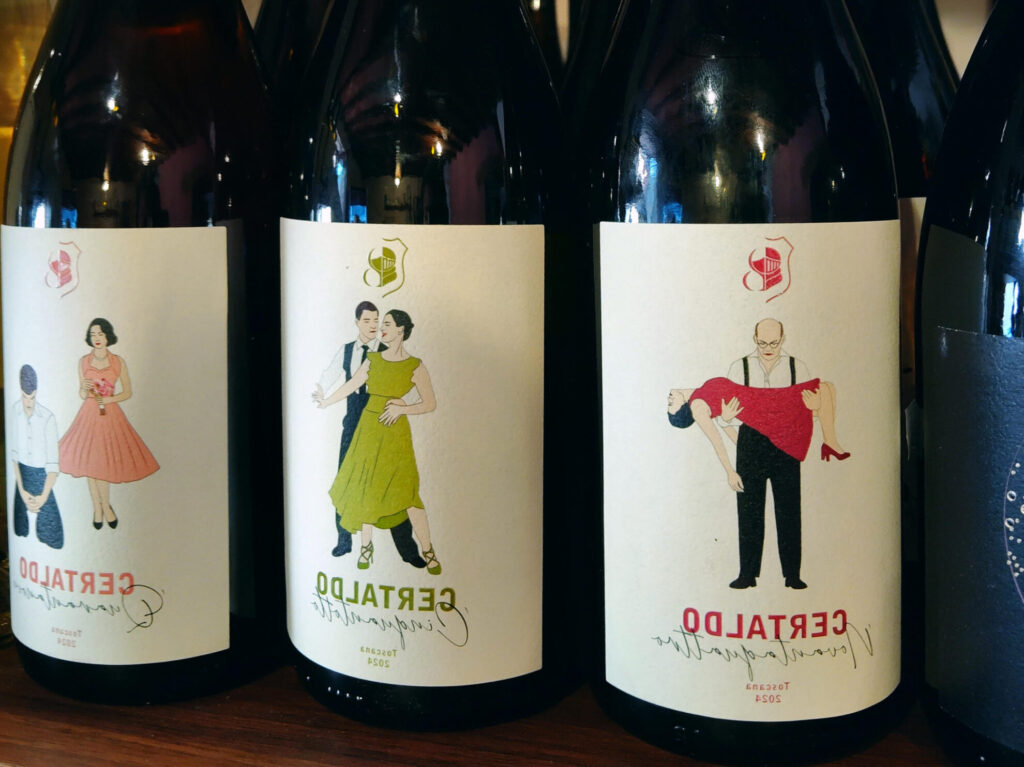
I need to breathe: I go for a walk in Certaldo Alta, a very charming medieval village. In a small shop, I stop to take pictures of some wine bottles with a sequence of images that strike me: a man bowing and a woman dressed in pink walking toward him with a bouquet in her hand; the two of them dancing happily on another bottle. On the last bottle, the image shows the elderly man holding the woman, who seems barely to react.
The shop owner comes over and tells me that it’s the life of a couple, which their children decided to represent on their wine bottles. The last image shows the husband holding his wife, now suffering from Alzheimer’s. My stomach twists, but I don’t tell him that I am in Tuscany to visit my aunt with Alzheimer’s.
I return to her, and she is still in the same position. Leaning to the right, eyes open staring into nothing, held in her wheelchair by a restraint, otherwise she would fall to the floor because her body constantly twists. Her brain is no longer able to control her muscles, which remain contracted, taut like violin strings.
Like many other diseases, this one is ruthless too: you are there, in front of a house collapsing, and you can do nothing while you watch it crumble, piece by piece. We have filled her with kisses, caresses, hugs, but aside from a few spasms hinting at tiny moments of minimal lucidity in which she seemed to respond yes/no, there’s no reply from her.
It’s evening, I have to leave, the ship departs in a few hours. While saying goodbye, I try again: “We have to go, aunt,” I say. With all her strength, she answers, and I barely understand: “Where are you going?”
I don’t know if she understood that we were her family, but surely she felt something. She didn’t want us to leave; she felt all the love we gave her in one day together.
We close the door, and as I walk away I think that maybe love exists for just this: staying close, even when the other no longer knows who you are. Someone once said that being human truly begins in front of another person’s face. In front of her still face, I understood what it means to remain human.