

There is one thing agro-pastoral societies were forced to do constantly: dominate, or rather, negotiate with nature.
Without rain there is no harvest; without a harvest, animals do not eat. If animals do not eat, they fall ill or die. And if livestock falls ill, humans do not eat either.
This is exactly the tension that Sardinian Carnival brings to the surface through its grotesque, dark and unsettling masks: the physical, real and constant struggle of humans trying to live with nature, or at least to tame it.
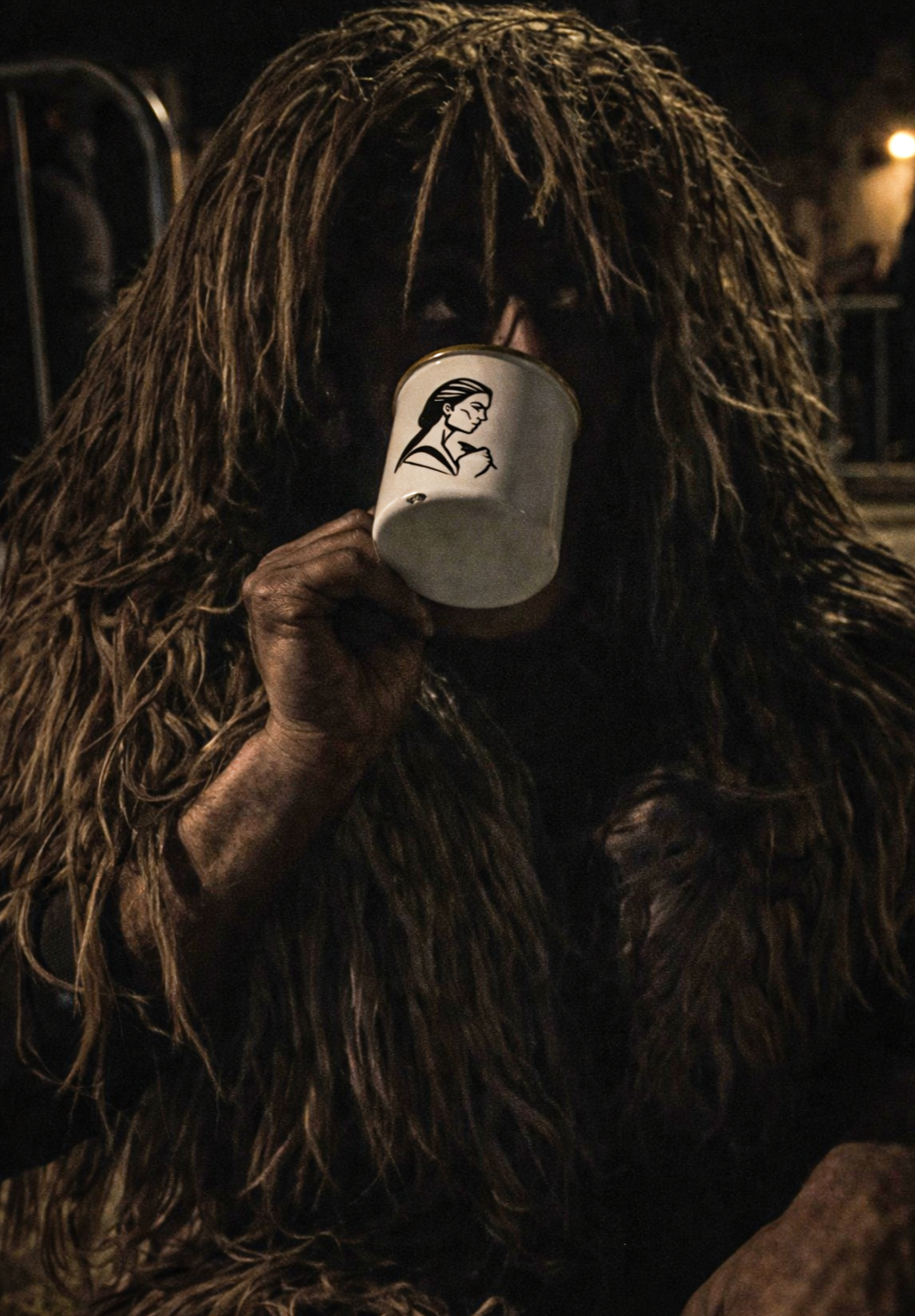
The tension between human culture and animal nature is particularly evident in the masks of Fonni: sos Urthos and sos Buttudos.
Sos Urthos are covered in an entire goatskin, wear a large cowbell around their necks and have their faces blackened. They appear out of control: they climb everywhere, slam their heads, throw themselves to the ground. Chained with iron links, they are kept in check by sos Buttudos. These figures also have blackened faces, but they are dressed in the traditional gabbanu of orbace wool, with the hood pulled low over the forehead, wearing heavy boots and leather gaiters typical of shepherds. Their task is to try to restrain sos Urthos, imposing beasts that embody the untamable force of nature.
Anthropologist Dolores Turchi places traditional Sardinian carnivals within a Dionysian framework, connected to a dark vision of symbolic death and rebirth. Within this framework, Urthos and Buttudos stage something that, in the agro-pastoral world, was extremely concrete: the indomitable force of nature, both necessary and dangerous, which humans can only contain, never eliminate. The animal force embodied by sos Urthos is not an enemy to be eradicated, but a power that must be held back, because human survival itself depends on it.
In the ancient world, this same force was conceived in different ways. When it was observed at the moment of ending, of return to the earth and the underworld, it was called Hades or Pluto. When it manifested as vital excess, loss of control and energy that breaks order, it was called Dionysus.
Hades is the god who receives what remains when something comes to an end. Dionysus is the god of instinct that exceeds limits. They are not opposing deities, but two ways of naming the same force within a single cycle: what explodes, is consumed, returns to the earth and from there becomes life again.
Sos Urthos embody this ambivalence: they are excessive, frightening, yet at the same time compelling, because they are unpredictable.
Sardinian Carnival serves to expose what society keeps under control for the rest of the year.
This does not speak only of the past, but of what each of us is forced to keep in check. The forces that are displayed and restrained do not disappear when the celebration ends; they remain, barely controlled, within everyday life.